
What Happens When You Declutter Half Your Stuff?

What would happen if you got rid of 50% of everything you own?
Would you miss your things? Would your house feel empty? Would you regret letting go of so much?
Over the last several years, my mom has slowly been finding out.
We started decluttering together around 2019. At first, we focused on the easier, smaller categories: clothing, jewelry, holiday decorations, drawers, closets, and other things that had accumulated over the years.
At the time, even that felt extreme.
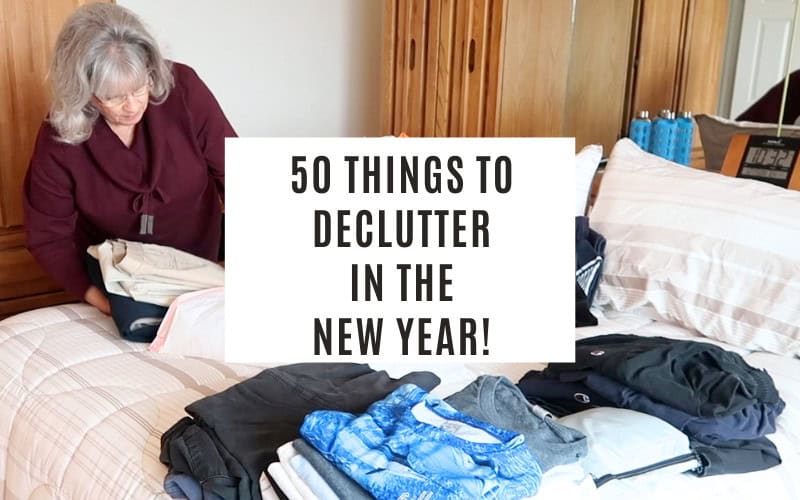
I remember pulling everything out of my mom’s closet and putting it on the bed. Seeing how much she owned altogether was shocking. Bags and bags left the house, and it felt like we had made a huge dent.
But looking back, that was really just the beginning.
Eventually, my parents decided to downsize from the home they had lived in for decades into a much smaller house. That’s when the decluttering really accelerated.
Between everything they let go of before the move and everything they have continued to declutter since moving, my mom estimates she’s gotten rid of at least 50% of what she once owned.
And the most interesting part isn’t how much she got rid of.
It’s how differently she feels about her belongings now.
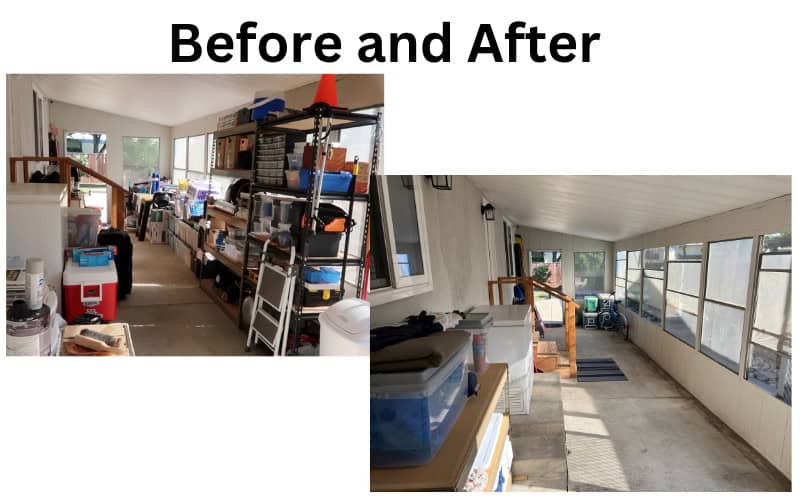
Decluttering 50% Didn’t Happen Overnight
What’s important to point out is that my mom didn’t wake up one morning and decide to get rid of half of everything she owned.
This happened over years.
At first, decluttering a closet felt extreme. There were plenty of things she wasn’t ready to let go of, and we didn’t force it.
Over time, something changed.
The more she decluttered, the easier it became to recognize what she actually used, loved, and wanted in her life.
This is something I’ve noticed again and again with decluttering: you get better at it with practice.
Decisions that once seemed incredibly difficult can become surprisingly easy a few years later.
READ: THE COMPLETE GUIDE TO DECLUTTERING AFTER 65 (FOR MORE INFO)
Downsizing Forced Us to Look at the Big Stuff
For years, most of our decluttering involved smaller items.
Then came the move.
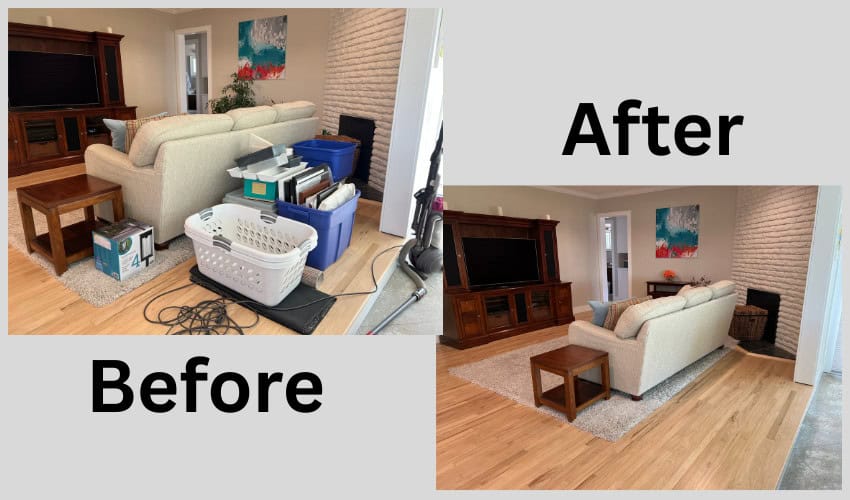
Suddenly, we weren’t deciding whether to keep another sweater or kitchen utensil. We were looking at entire rooms full of furniture.
My parents got rid of a refrigerator, file cabinets, desks, bookshelves, office chairs, framed artwork, a piano, two large recliners, curio cabinets, rugs, mirrors, dressers, a bed, a headboard, a hope chest, a television console, and much more.
In my dad’s old office alone, they let go of a four-drawer filing cabinet, a desk with a large top, two bookshelves, and a rolling chair.
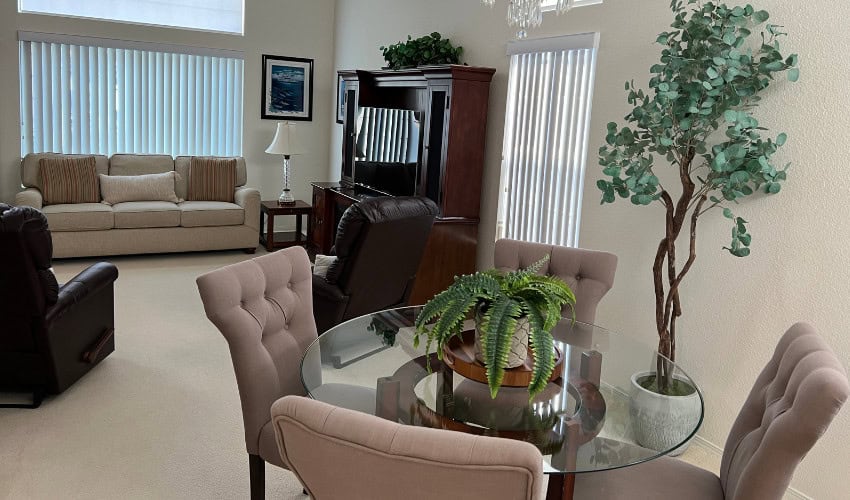
Their living room changed even more dramatically. They basically moved only their couch, entertainment unit, and a couple of small side tables into the new house.
The new home simply didn’t have room for everything from the old one.
And that turned out to be a good thing.
Having Storage Space Doesn’t Mean You Need to Fill It
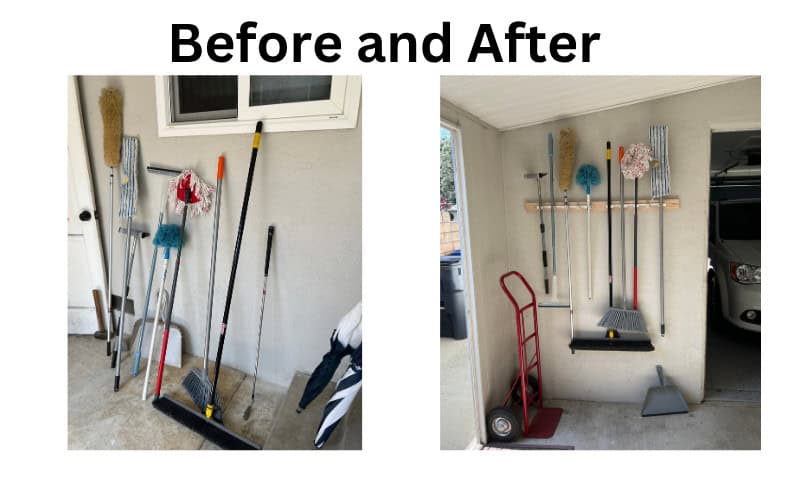
One of the biggest realizations my mom has had through this entire process is that she used to keep things simply because she had somewhere to put them.
If something fit in a drawer, cabinet, closet, or labeled box, there wasn’t much reason to get rid of it.
The old house had plenty of places to hide things.
The new house doesn’t.
And instead of missing all that storage, she’s discovered she actually likes having less of it.
There aren’t as many places to put things away and forget about them. If something is taking up valuable space, she has to ask herself whether she really wants to keep it.
That simple limitation has completely changed the way she thinks about her belongings.
The Hardest Things to Declutter Weren’t Necessarily Valuable
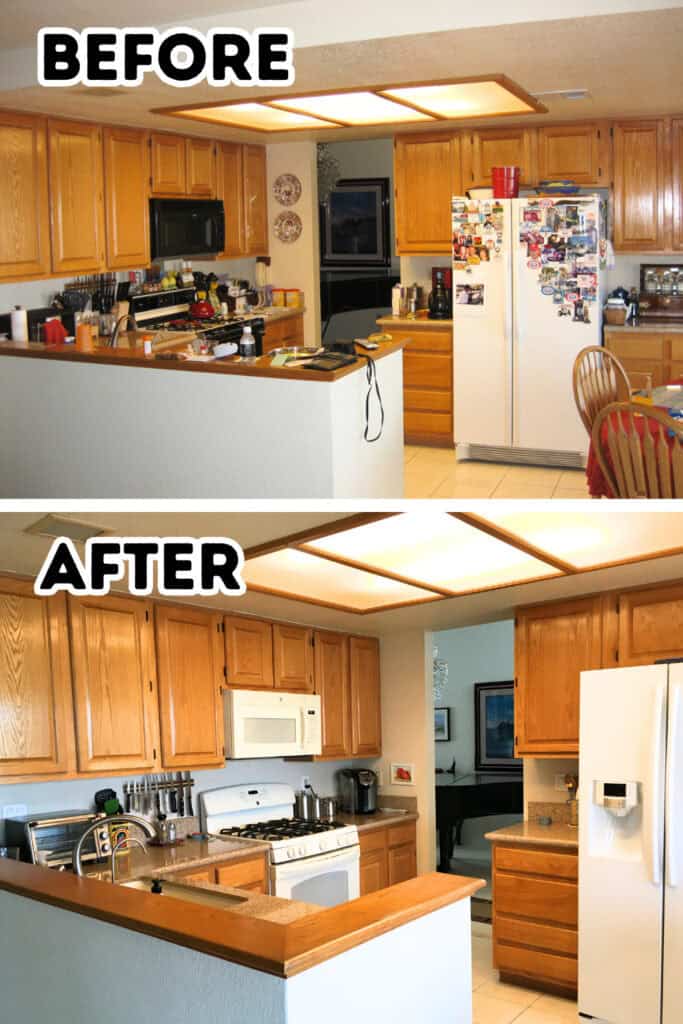
Unsurprisingly, some of the hardest things to let go of were sentimental items.
My mom had inherited items from family members who had passed away, and for years she felt a strong connection between those objects and the people who had owned them.
Letting go of the object almost felt like letting go of the person.
It took years for that feeling to change.
Eventually, she realized something important: the item isn’t the person.
She can keep the memories and love she has for her grandparents without keeping everything they once owned.
She has also learned that letting go of sentimental items doesn’t mean they have to go into the trash. For quality antiques and vintage pieces, she has taken the time to find antique dealers or other people who actually want them.
Knowing something is going to a new home can make letting go much easier.

Collectibles Were Easier to Let Go of Than Expected
Another category my mom struggled with was collectibles.
Like a lot of people, she had been told that certain collectibles would eventually become valuable.
Something that cost $50 might supposedly be worth hundreds someday.
But decades later, many of those items weren’t worth anywhere near what she had expected.
More importantly, she no longer wanted them.
Once she stopped looking at the collectibles as investments and started asking whether she actually wanted to own and display them, letting them go became much easier.
This is a good question to ask when you’re decluttering:
If this item weren’t supposedly valuable, would I still want it?
Sometimes we’re not holding onto the object. We’re holding onto what we think the object should be worth.

We Still Moved Things We Eventually Decluttered
Even after all that decluttering, we didn’t get every decision right before the move.
We weren’t sure about several things, so we decided to bring them to the new house and figure it out later.
One was a tall curio cabinet filled with collectibles.
Almost immediately after it arrived, my mom knew she didn’t want it in the new house.
The same thing happened with their old dining table and chairs and a large buffet.
Looking back, she wishes she had let some of those things go before paying the price, in both time and effort, to move them.
But I don’t necessarily think those were mistakes.
Sometimes you need a little more time.
Seeing a piece of furniture in the new space can give you the clarity you didn’t have before.
If you’re downsizing, you don’t have to make every difficult decision immediately. You can give yourself permission to decide later.
Just make sure “later” doesn’t turn into another 20 years.
The Decluttering Continued After the Move
Something I didn’t expect was how much my mom would continue decluttering after moving.
You might assume that after getting rid of roughly half of your belongings, you’d be finished.
Instead, moving into a smaller home made my mom want to simplify even more.
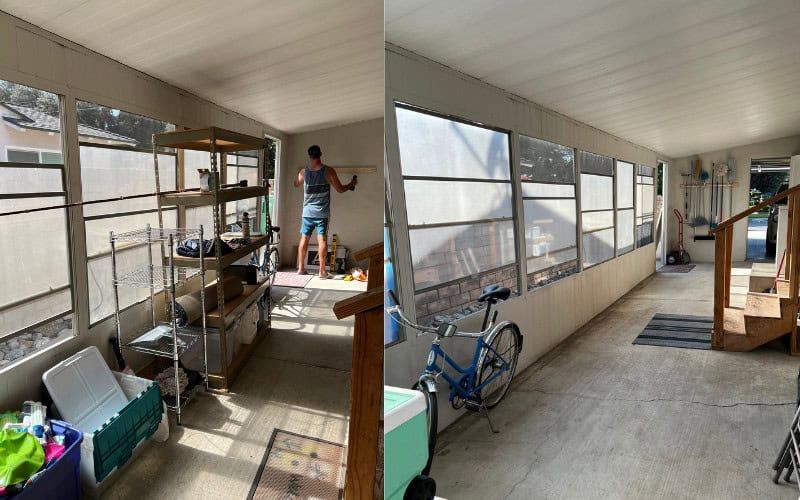
We’ve continued decluttering clothing, kitchen items, garage supplies, vintage pieces, sentimental belongings, and everyday household items.
My mom now keeps a donation box going and regularly takes things to the thrift store.
The difference is that now she notices clutter much faster.
Empty Space Started to Feel Better Than Full Space
This may be the biggest change of all.
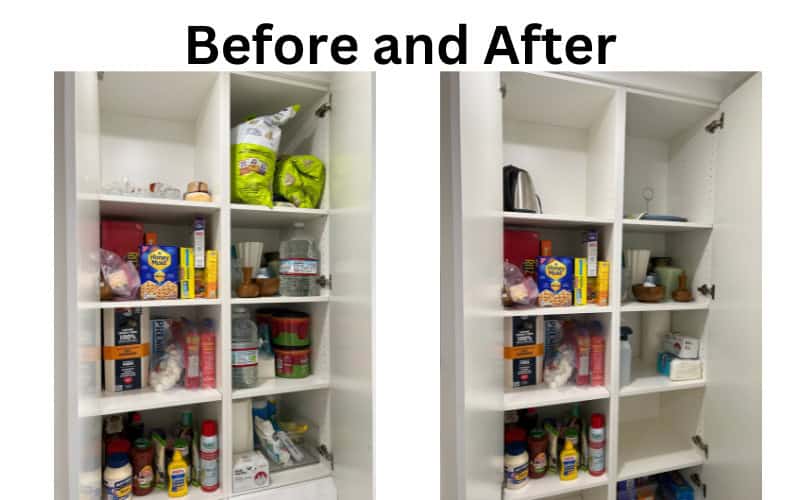
My mom used to look at an empty shelf and see space available for storage.
Now she sees the empty shelf itself as something valuable.
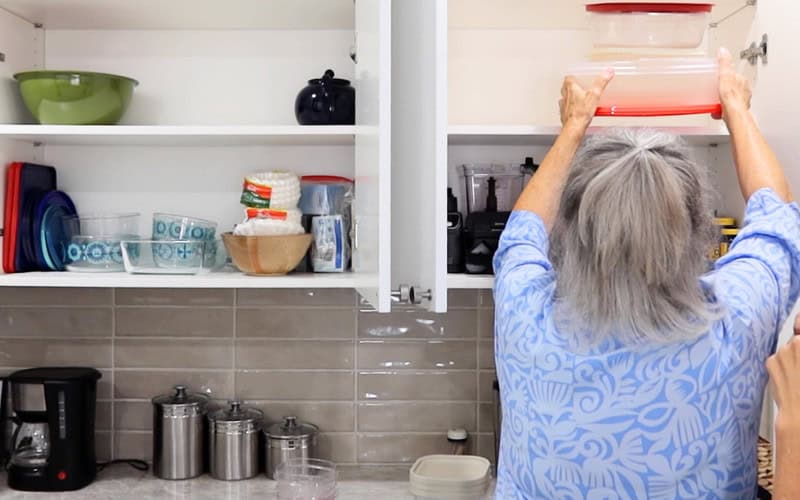
She doesn’t want to dig through stacks of things to reach what she needs. She doesn’t want every cabinet packed. She doesn’t want to climb onto a step stool and lift heavy glass items over her head just because that’s the only available storage space.
She wants to open a cabinet and easily see what’s inside.
She wants one or two things on a shelf instead of ten.
She wants space.
Once you start appreciating empty space, decluttering becomes much easier because you realize that the choice isn’t simply:
Keep the item or get rid of the item.
It’s:
Keep the item or keep the space.
Sometimes the space is worth more.
Our Homes Need to Change With Us
Another important lesson from my parents’ downsizing experience is that our homes should work for the stage of life we’re currently in.
Something that worked 20 years ago might not work today.
For example, my mom recently decluttered a large amount of glassware and other kitchen items that had been stored on high shelves.
She realized she didn’t want to climb on a step stool and lift heavy glass over her head anymore.
So we went through everything, got rid of a lot of it, rearranged the kitchen, and moved the things she actually uses to more accessible shelves.
Decluttering wasn’t just about making the kitchen look better.
It made the kitchen safer and easier for her to use.
That’s an important consideration as we get older.
Instead of asking only, “Do I have room for this?” we can also ask:
“Does this item make my life easier or harder right now?”
The Biggest Benefits of Getting Rid of Half Your Stuff
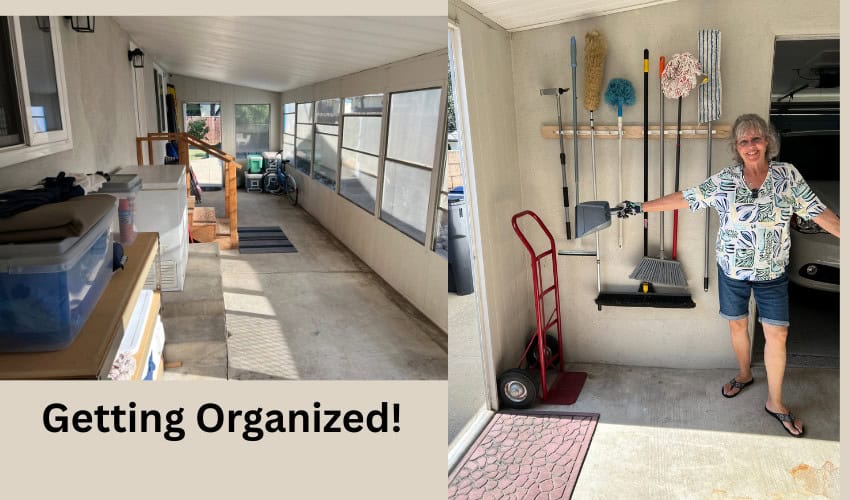
After years of decluttering, we’ve seen some practical benefits.
The house is easier to clean.
Things are easier to find.
Putting things away is easier because everything has a place.
There are fewer things to maintain.
My mom also shops much less than she used to. Shopping for home decor and little extras simply isn’t as interesting anymore because she doesn’t want to refill the space she worked so hard to create.
But one of the biggest benefits is harder to see.
She feels calmer.
Physical Clutter Can Become Mental Clutter
During our conversation, my mom said something that perfectly explained why she wants to continue decluttering.
She said that clutter now feels like mental clutter.
Even when something is hidden away, she knows it’s there.
There are photos to sort.
Art supplies to organize.
Boxes to go through.
Things to clean.
Things to sell.
Things she needs to decide what to do with.
Every object can become another tiny unfinished task sitting somewhere in the back of your mind.
I completely understand that feeling because it’s one of the reasons I started decluttering years ago.
I’d see something and think:
I need to clean that.
I need to put that away.
I need to organize that.
I need to decide what I’m doing with that.
Then, when I finally let it go, the task disappeared along with the item.
I didn’t have to think about it anymore.
That’s when decluttering becomes about much more than having a tidy house.
You’re also removing things from your mental to-do list.

Does Decluttering Get Easier?
In my mom’s experience, absolutely.
If she could go back to the beginning knowing what she knows now, she says she would probably get rid of almost everything immediately.
But she also admits she couldn’t have done that then.
She had to build what we sometimes call her decluttering muscles.
She needed experience letting things go and realizing she didn’t regret it.
She needed to see what life felt like with less.
She needed time to separate sentimental objects from sentimental memories.
And she needed to discover how much she enjoyed having open space.
That’s why I don’t think you should compare the beginning of your decluttering journey with someone else’s fifth or tenth year.
Start where you are.

Will We Ever Be Completely Done Decluttering?
Probably not.
My mom still finds things.
A drawer gets messy. Pens accumulate. Clothes wear out. Something she thought she needed six months ago suddenly doesn’t seem important anymore.
But decluttering isn’t the enormous emotional project it once was.
It’s becoming part of everyday life.
See something you don’t use?
Let it go.
Notice something is broken?
Get rid of it.
Open a drawer that’s getting crowded?
Spend ten minutes going through it.
The goal isn’t to reach some magical point where you never have to declutter again.
The goal is to make decluttering so normal that your home never becomes overwhelmingly cluttered again.

What Would She Tell Herself Before Starting?
At the end of our conversation, I asked my mom what she would tell herself if she could go back to the beginning of this entire journey.
Her answer was simple:
Let things go.
You’re probably not going to regret getting rid of the things you don’t really want or need.
Instead, you may discover that having less makes your life more comfortable, calmer and less stressful.
And after watching my mom go through this process for years, I think that’s the biggest lesson from getting rid of 50% of everything.
It isn’t really about owning half as much.
It’s about discovering how much you actually need to live the life you want now.
And sometimes, having less stuff gives you more room for that life.
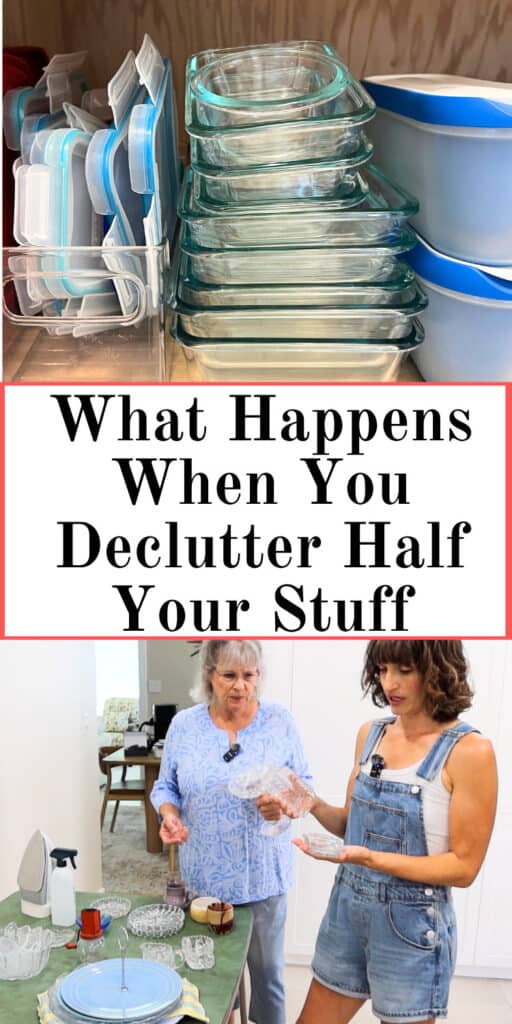
Pin: What Happens When You Declutter Half Your Stuff?



Such an interesting journey. I also get better decluttering muscles every year. Our brains see physical items different over time. And the clutter is like a long to do list. Thanks for sharing this journey with us and inspiring our own.
I agree! Thank you for reading =)
Thanks for the beautifully written article Shannon! I related to every word you wrote, as I am 67 and trying to downsize and move to a place 400 miles away to be near one of my daughters (currently in SoCal, moving back to Bay Area where I am from). I too will more than likely be moving into a place half the size of my current home, as that will be all I can afford where I will be moving.
I have decluttered a lot over these past few years, but still have so much further I know I need to go.
I am so happy you decided to share your mom’s journey on your channel, it has really helped me see what to expect regarding moving (and soooo much more than that too).
I only wish my daughters lived closer because I NEED A SHANNON and HER HANDY HUBBY! haha…I know your mom & dad are grateful for you two and they are so fortunate to have you so close. I’m on my own with the decluttering, downsizing. packing, real estate stuff and the move itself and it feels like I will never get there…totally overwhelming amount of work still ahead. Every day. I just forge on and keep working at it all. I have no other choice if I want to move. I am also still working full time, so progress feels so slow.
When you are surrounded by a lifetime of stuff and you begin to think about moving. it’s as if you have created your own prison…one you can’t break free from until the stuff is gone. Your stuff holds you hostage! But I am determined to get out of this prison of possessions and live a life of peace & freedom one day!
Thanks for all the inspiration and education you share on your YouTube channel and this blog. Really appreciate your work and your style.
Sincerely. Lisa P.
Thank you for sharing your story! I wish you luck on your big move, and I hope it goes well.