
10 Harsh Decluttering Truths You Need to Know!
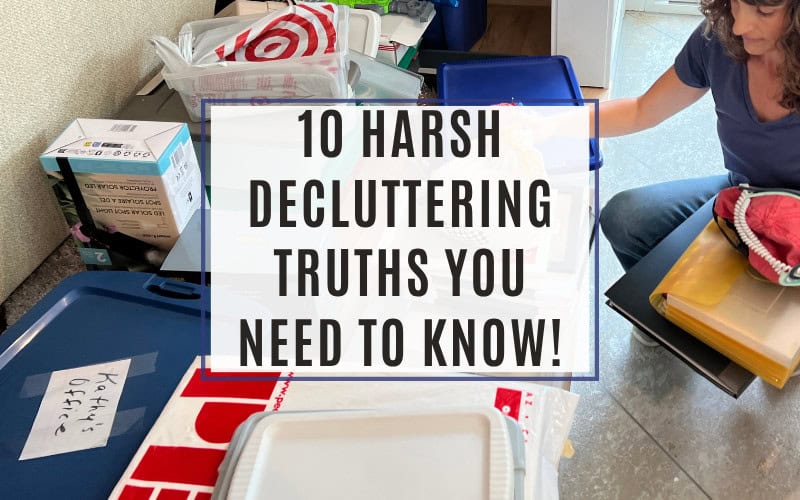
After years of decluttering my own home and helping my parents declutter and downsize, I’ve learned that getting rid of clutter isn’t always as simple as it sounds.
There are a lot of emotions involved. There are things we think we should keep, things we feel guilty getting rid of, and things we’ve been meaning to deal with for years.
My mom and I have been decluttering together for about eight years now, and along the way, we’ve learned some lessons the hard way.
Some of these might not be what you want to hear, but they can completely change the way you think about the things in your home.
Here are 10 harsh decluttering truths that might finally help you let go.
10 Harsh Decluttering Truths You Need to Know:
1. Things You Once Needed Will Eventually Become Clutter
One of the biggest things I’ve learned is that clutter isn’t always the result of buying things we never needed.
Sometimes an item was incredibly useful at one point in our lives.
Think about everything that comes with having a baby. You might have a stroller, crib, baby clothes, toys, bottles, high chairs, and countless other things that you genuinely need during that stage of life.
But your kids grow.
Eventually, those useful items aren’t useful anymore.
The same thing happens with hobbies, clothing, work supplies, sports equipment, kitchen items, and just about everything else we own.
Something that was useful five or ten years ago can still be clutter today.
That doesn’t mean buying it was a mistake. It simply means your life has changed.
One of the most important parts of decluttering is continually asking yourself:
Does this item still fit the life I’m living today?
Your home doesn’t have to remain a storage space for every previous version of your life.

2. If You Know You Don’t Want Something, Stop Putting Off the Decision
My mom brought up a blouse that she had been thinking about getting rid of for around five years.
Five years!
She knew she didn’t really want it, but instead of getting rid of it, she would think about it, put it back, and deal with the same decision again later.
I think a lot of us do this.
We pick something up and think, I should probably get rid of this.
Then we put it back.
Six months later, we pick it up and have the exact same conversation with ourselves.
All we’re doing is postponing a decision we’ve basically already made.
When you know something needs to go, put it directly into your donation box.
You’ll save yourself years of storing, organizing, moving, cleaning around, and repeatedly reconsidering something you don’t even want.

3. Not All Clutter Is Stuff You Wasted Money On
I once saw a comment that said something along the lines of:
All of that clutter used to be money.
That really stood out to me.
And sometimes it’s true. We’ve probably all bought things on impulse that we later realized we didn’t need.
But not everything cluttering our homes is something we bought.
Some of it was free.
Some was handed down to us.
Some was given as a gift.
Some came from friends or family members who were getting rid of their own things.
When my kids were little, I was happy to accept hand-me-downs and free kids’ items. It was incredibly helpful.
But eventually, I realized I needed to limit how much I accepted.
Suddenly we had too many kids’ clothes, too many toys, and simply too much stuff.
Free stuff can still become clutter.
Before accepting something just because it’s free, ask yourself whether you would actually choose to bring it into your home if you had to pay for it.
If the answer is no, you probably don’t need it.
Watch The Decluttering Video Here:

4. Something Being Valuable Doesn’t Mean You Have to Keep It
This is something my mom has struggled with in the past.
She would hold onto items because someone told her they were valuable.
Maybe they were antiques. Maybe they were collectibles. Maybe someone said they would be worth money someday.
But she wasn’t using them.
She wasn’t displaying them.
And in some cases, she eventually discovered they weren’t worth nearly as much as she thought.
She had essentially been providing free storage for items she didn’t even like.
We’ve finally come to the conclusion that an item’s supposed monetary value isn’t a good enough reason to keep it.
If something is valuable to you, that’s different.
Maybe you love looking at it. Maybe you use it. Maybe it reminds you of someone special.
But keeping something you don’t like because you think you might sell it for a lot of money someday can keep you stuck with clutter for years.
If you’re not using it, enjoying it, or realistically planning to sell it, its perceived value may not matter very much.

5. Clutter Will Come Back If You Stop Paying Attention
I wish you could declutter your entire house once and be done forever.
Unfortunately, it doesn’t work that way.
Clutter creeps back in.
Even when you’re careful about shopping and try to follow rules like one-in, one-out, things still enter your home.
Kids bring things home.
People give you things.
You buy new clothes.
Paperwork appears.
Holidays happen.
Your needs change.
Sometimes I can go into my kids’ rooms and somehow find enough random things to fill an entire trash bag. I don’t even know where half of it came from!
That’s why I think decluttering works best when it becomes part of your normal routine.
Throughout the year, I regularly reassess what we have.
Am I actually wearing these clothes?
Are we using these kitchen items?
Do my kids still play with these toys?
Do we still need this?
You don’t have to do huge decluttering projects all the time. Small, regular decluttering sessions can keep clutter from slowly taking over again.

6. Decluttering Gets Harder as You Get Older
This is one of the biggest lessons we’ve learned while helping my parents downsize.
Decluttering has a physical side that people don’t always think about.
You have to move boxes.
You have to bend down.
You have to pull things out of cabinets.
You have to sort through garages, attics, closets, and storage spaces.
And then there is the mental side.
You have to make hundreds, sometimes thousands, of decisions.
My mom experienced this firsthand when her dad passed away. He had collections of things that she had asked him to go through while he was still alive.
His response was essentially that he would leave it for her to deal with.
And that’s what happened.
After he passed away, she had to sort through those belongings, figure out what they were, find people who might want them, sell some things, donate others, and make all of those decisions herself.
It was difficult.
That experience is one reason my parents decided they wanted to take control of their own belongings while they could still make those decisions.
If you’re thinking about decluttering or downsizing someday, don’t assume you’ll have more energy to deal with everything ten years from now.
Declutter while you are physically and mentally able to make the decisions yourself.

7. You Won’t Always Find the Perfect Home for Everything
This has been difficult for both my mom and me.
We want our things to go to the perfect person.
If we’re getting rid of something nice, we want to know someone will appreciate it.
So we hold onto it while trying to figure out where it should go.
And sometimes those items sit in boxes for months.
At some point, you have to decide what’s more important: finding the absolute perfect destination for every item or actually getting the clutter out of your house.
Of course, it’s wonderful when you can give something directly to someone who needs it.
But that’s not always going to happen.
Sometimes you need to donate the item to a thrift store and let it go.
Otherwise, you can end up with boxes of things waiting to be donated, sold, given away, or dealt with “someday.”
Don’t let finding the perfect home for your clutter become another form of clutter.

8. Other People Don’t Want Most of Your Stuff
This might be one of the harshest truths on this list.
Just because something was expensive doesn’t mean someone else wants it.
Just because something is in great condition doesn’t mean your kids want it.
And just because you think something is valuable doesn’t mean a thrift store will take it.
We learned this when cleaning out my grandpa’s house.
He had really nice furniture that had been well cared for and was still in great condition.
We thought it would be easy to give away.
It wasn’t.
We tried selling it.
We tried offering it for free.
We tried different donation locations.
It was surprisingly difficult to find anyone who wanted some of it.
This is something to keep in mind when you’re saving things for other people.
Your kids may not want your furniture.
Your relatives may not want your collections.
A thrift store may not accept certain items.
And sometimes you may even have to pay someone to haul things away.
That doesn’t mean the item was worthless. It simply means its usefulness to you doesn’t automatically transfer to someone else.

9. Everyone Has a Different Clutter Threshold
One thing I’ve noticed is that people have very different ideas about what “too much stuff” looks like.
Someone can live in a large house with a lot of belongings and the home doesn’t necessarily look cluttered because everything is spread out.
Move those exact same belongings into a much smaller home, and suddenly it feels overwhelming.
This became especially obvious while my parents were downsizing.
We all have what I think of as a clutter threshold.
Some people genuinely enjoy having more things around them.
Other people, like me, feel stressed when there is too much stuff sitting out.
Neither person has to follow someone else’s exact decluttering rules.
Instead, figure out how much you personally want to manage.
Ask yourself:
- How much do I want sitting on my counters?
- How full do I want my closets?
- How much clothing do I realistically want to maintain?
- How much time do I want to spend organizing my belongings?
- Does the amount of stuff I own make my life easier or harder?
Your goal doesn’t have to be becoming a minimalist.
Your goal should be getting to the point where your belongings fit comfortably into your home, and you can manage them without feeling overwhelmed.

10. Organizing Isn’t the Same as Decluttering
This might be the most important truth of all.
You cannot organize your way out of having too much stuff.
For years, we would sometimes go through my parents’ house and mostly move things around.
Something would move from one cabinet to another.
A pile would move into a closet.
We’d put things into bins.
Maybe we’d get rid of a few things, but mostly we were rearranging.
My mom eventually came up with a name for this: shifting the clutter.
Organizing has its place, but organizing and decluttering are two completely different things.
Decluttering reduces how much you own.
Organizing finds a home for what remains.
And organizing becomes much easier once you’ve actually removed the things you don’t need.
The good news is that decluttering also gets easier with practice.
When my parents first started, letting go was much harder. But over the years, they built what we like to call their decluttering muscle.
The more they saw the benefits, the easier it became.
Now my mom can open a cabinet and see empty space.
Her closet doesn’t have clothes packed into every available spot.
Her garage isn’t overflowing.
She can find things more easily.
And most importantly, she gets to enjoy her home.

The Biggest Decluttering Truth: You Have to Start
There is one final lesson that connects all of these harsh decluttering truths:
If you want to enjoy a clutter-free home someday, you have to start now.
My parents didn’t transform their home overnight.
It took years.
But my mom now talks about how much she enjoys opening a cabinet and seeing extra room. She doesn’t have boxes of clothing under the bed or things hidden everywhere.
Instead of constantly managing stuff, she has more time and space to focus on things she actually enjoys, including her art.
That’s really what decluttering is about.
It’s not about having the emptiest house.
It’s not about getting rid of everything you own.
It’s about removing the things that no longer serve you so you have more room for the things that do.
And you don’t have to declutter your entire house this weekend.
Start with one drawer.
One cabinet.
One shelf.
One donation box.
Every item you let go of is one less thing you have to store, clean, organize, move, or eventually make a decision about.
Start small, keep going, and eventually you may look around your home and realize you’re finally living the clutter-free life you were working toward.



Great article. Someone mentioned that decluttering is like gardening. Constantly tending to your home, “de-weeding” and tending to your space to remove items that no longer serve you.
That is such a great way to think about it. Thank you for sharing =)