
Decluttering and Rearranging A Home Without Buying Anything
Decluttering and Rearranging a Home Without Buying Anything New
Sometimes the best way to organize your home isn’t to buy new furniture, storage bins, or organizers. Sometimes all you need is to declutter what you already have and rethink how you’re using your space.
Recently, I went back to my friend Ellen’s house to help her continue decluttering and reorganizing. We’ve already been working on her kitchen, but this time we tackled an area that served as her home office, along with a large cabinet filled with dishes, sentimental items, and all kinds of miscellaneous things.
Our bigger plan is to eventually rearrange her kitchen, move the refrigerator, and create more pantry storage. But before we can start moving everything around, we need to make room.
The goal for this project was simple: declutter first, rearrange second, and use what we already have instead of buying anything new.
And by the end of the day, we had completely changed how part of her home was functioning without spending any money!
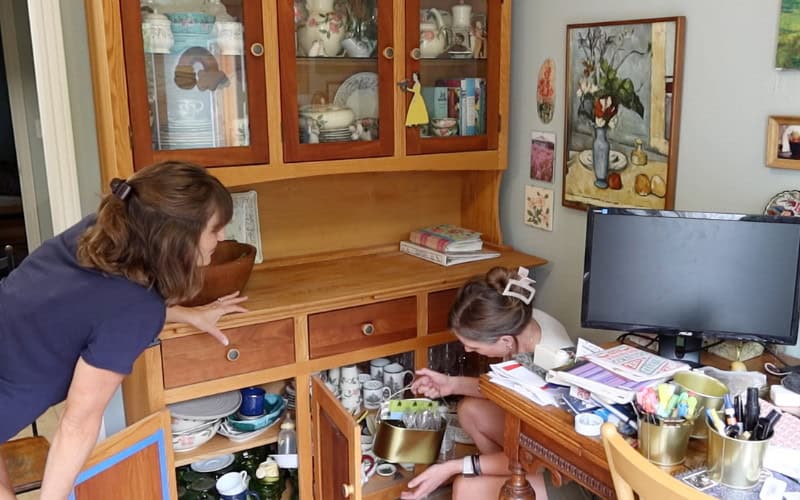
Decluttering an overwhelming space before moving furniture to create a new office.
Starting With a Cluttered Home Office
Ellen’s original office area was located right next to her kitchen and front door.
Although she used this space as a desk, it had also become a catchall for the entire family.
Every time the kids came through the front door, things would get dropped on or around her desk. Instead of having a dedicated workspace, she constantly had to deal with everyone else’s belongings.
I think this happens in so many homes.
When you have a flat surface in a convenient location, it naturally becomes a dumping ground. Mail, school papers, bags, and random items start collecting there.
Eventually, the space loses its original purpose.
We decided that moving her office away from the front door might solve several problems at once.
Not only would it free up space for the future kitchen makeover, but it could also give Ellen a quieter, more dedicated area to work.
Of course, before we could move anything, we had to deal with the clutter!
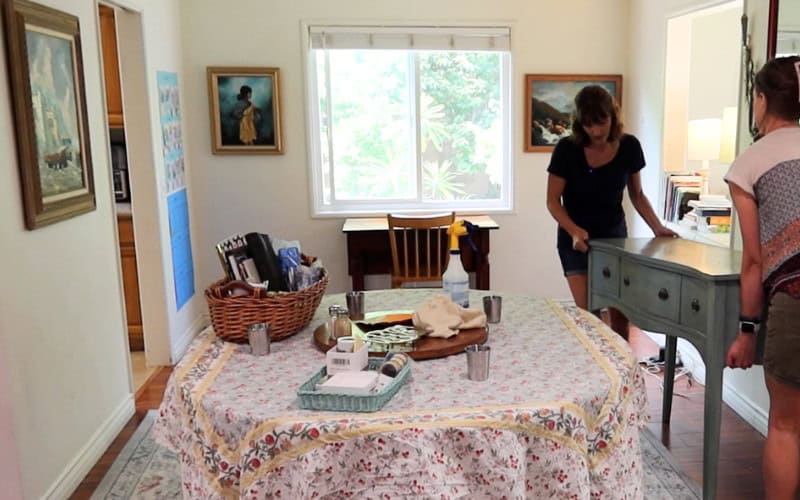
Moving furniture out of the way to create a new office area.
Decluttering a Cabinet Full of Random Things
The first big project was going through a cabinet near her original desk.
This cabinet held a little bit of everything.
There were office supplies, birthday decorations, stationery, cookbooks, sentimental dishes, holiday decorations, and plenty of things Ellen had forgotten she even owned.
At first, she thought there probably wouldn’t be much to declutter because so many of the items were sentimental.
But once we started opening drawers and pulling everything out, she realized there was actually quite a bit she was ready to let go of.
1. Start With the Easy Decisions
One thing I always recommend when decluttering is to start with the easiest items.
You don’t need to begin with sentimental belongings or things that require a lot of thought.
Instead, look for:
- Trash and broken items
- Things you no longer use
- Duplicates
- Old papers and expired coupons
- Decorations you don’t enjoy
- Items that belong somewhere else
As we went through the drawers, Ellen quickly found several things she no longer needed.
She had two happy birthday signs and decided to keep just one. She also found an unused cake decoration, old coupons, and other miscellaneous items that could go.
These might seem like small decisions, but they add up.
Every item you remove makes it easier to see what you actually want to keep.
Sometimes, making a few easy decisions gives you the momentum to tackle the harder ones.
2. Keep Similar Items Together
Another thing we noticed was that Ellen had office supplies scattered throughout several different drawers.
Pens, markers, stationery, envelopes, a label maker, and other supplies were mixed in with decorations and household items.
Because we were moving her office, it made sense to pull everything out and group it together.
We didn’t need to figure out the perfect organizing system right away.
Instead, we focused on gathering everything that belonged in the new office area.
This is an important part of organizing that people sometimes skip.
Before buying organizers, figure out what you actually need to store.
You might discover that you need much less storage than you originally thought.
Once everything is together, it’s easier to spot duplicates or supplies you no longer use.
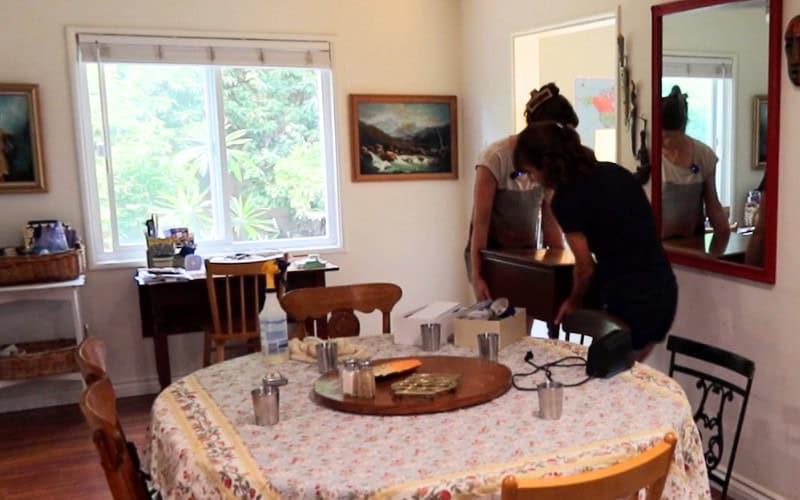
Moving furniture and creating a new office area.
Decluttering Sentimental Items Without Feeling Guilty
One of the biggest challenges during this project was going through Ellen’s sentimental belongings.
The cabinet contained wedding gifts, dishes from grandparents, family keepsakes, and decorations she had owned for years.
Sentimental clutter can be especially difficult because you’re not just deciding whether you like an object.
You’re also thinking about the person who gave it to you, the memories attached to it, and whether you might regret letting it go.
But I think it’s important to remember that you can appreciate a gift or a memory without keeping every physical item associated with it.
It’s Okay to Let Go of Gifts
At one point, Ellen pulled out a set of candlesticks she had received as a wedding gift.
They were perfectly nice candlesticks, but they weren’t her style.
She didn’t particularly enjoy using them and would rather have something different.
Still, she hesitated because they had been a gift.
I reminded her that it was okay to let them go.
Just because someone gave you something doesn’t mean you have to keep it forever.
A gift is meant to be enjoyed, not to become a lifelong obligation.
If something no longer fits your style or the way you live, you can pass it along to someone else.
Keep the Sentimental Things You Actually Love
Ellen also had several sets of dishes that held different memories.
Some of her Christmas dishes had belonged to her grandmother, and she still enjoyed bringing them out during the holidays.
Those were easy to keep.
But she also had a set of wedding china plates that chipped very easily.
She had stopped using them years ago and actually thought she had already gotten rid of them!
Once she realized they were still in the cabinet, she decided to let the plates go while keeping some matching serving and baking pieces she still liked.
This is a great example of how sentimental decluttering doesn’t have to be all or nothing.
You don’t have to keep an entire collection just because part of it is meaningful.
Sometimes keeping a few favorite pieces is enough.
Ask Yourself Whether You Would Use It Today
Another interesting discovery was a collection of goblets Ellen hadn’t used since moving into her house six years earlier.
Instead of deciding immediately whether to keep them, we took them out and put them in the giveaway pile to see how she felt.
Sometimes physically separating yourself from an item helps you make a decision.
When something has been sitting in a cabinet for years, you might assume you need it simply because you’ve always had it.
But once you take it out and imagine your home without it, you may realize you’re perfectly happy letting it go.
And if you’re really unsure, you don’t have to make the decision immediately.
Take time to think.
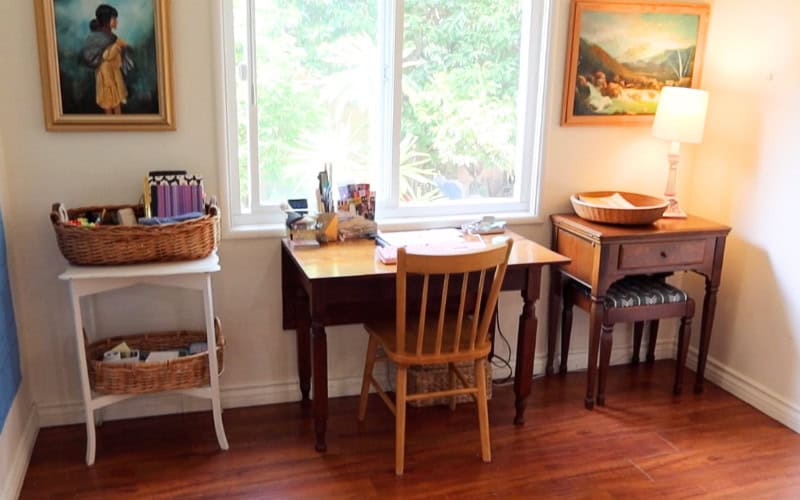
Making a new office area using the furniture Ellan already had in her home.
Organizing Doesn’t Have to Happen All at Once
One of my favorite things about working with Ellen is that she’s willing to try things and see what works.
As we decluttered, we started thinking about how she could store her office supplies in the new location.
Instead of buying a brand-new drawer unit, we found a storage piece she already owned that could work temporarily.
This was perfect because we weren’t even sure exactly how the new office layout would function.
There was no reason to spend money on organizers before she could use the space.
Sometimes the best organizing solution is a temporary one.
You can put your belongings in a basket, drawer, or container you already have and live with it for a while.
Then, after a few weeks, you’ll have a better idea of what you actually need.
You might discover that your temporary solution works perfectly well.
Or you might realize you need something completely different.
Either way, you’ve avoided buying something that might not work.
Decluttering Gets Easier the Second Time
While we were going through everything, Ellen mentioned that she could probably declutter even more later.
And I completely agree.
I’ve noticed that once you’ve gone through an area the first time, it often becomes much easier to declutter it again.
The first time, you might still feel attached to certain things or worry that you’ll need them.
But after living with your organized space for a while, you start noticing what you actually use.
You also become more comfortable making decisions.
This is why I don’t think decluttering needs to be a one-time event.
You can keep simplifying your home little by little.
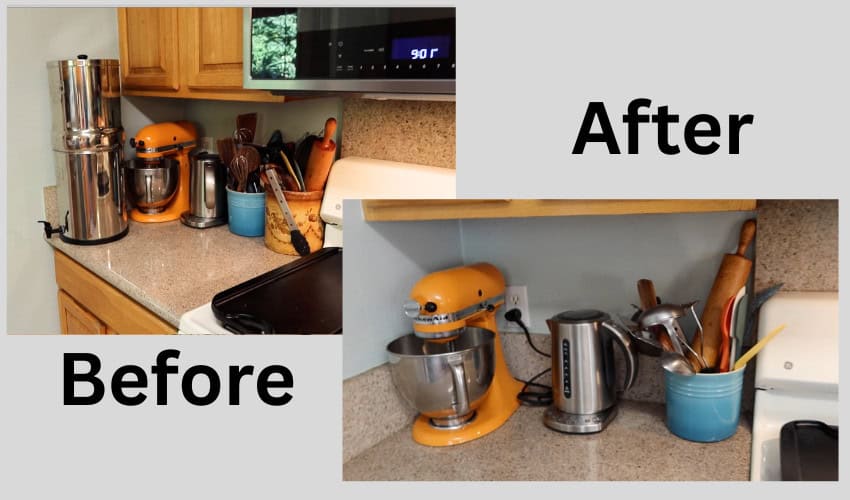
The kitchen before and after we started decluttering.
Rearranging Furniture to Create a New Home Office
Once we finished going through the cabinet, it was time for the fun part!
We wanted to create a new office area in Ellen’s dining room.
Her home has a large, somewhat awkward open space between the dining and living areas.
It had always been difficult to figure out how to use that space effectively.
Since our homes have similar floor plans, I understood exactly what she meant.
Sometimes a room can have plenty of square footage but still feel difficult to arrange.
We planned to move the dining table and create a dedicated office area along one wall.
We also planned to swap a table from her son’s room with another table in the house.
We also found a beautiful vintage sewing table that belonged to Ellen’s grandmother.
By bringing that piece into the new office area, we could give it a useful purpose while also making another area of her home less crowded.
I love when you can take furniture that already has meaning and find a new way to use it.
Instead of storing a sentimental piece or leaving it somewhere it doesn’t function well, you can incorporate it into your everyday life.
Shopping Your Own Home First
Throughout this entire makeover, we made a point of looking around Ellen’s house for furniture and storage solutions.
We weren’t trying to create a perfect room with all-new matching furniture.
We were trying to make her home work better with the things she already owned.
I highly recommend trying this before you go shopping.
Look around your home and ask yourself:
- Could a table from another room work better here?
- Do I have a basket or container that could organize these supplies?
- Is there a piece of furniture I’m not using to its full potential?
- Could moving something solve a problem without buying anything?
- Can I repurpose something I already own?
You might be surprised by what you come up with.
In Ellen’s case, we pulled together an entirely new workspace using existing furniture.
We also incorporated a rug my mom had originally bought for her dining room makeover but didn’t end up using.
Rather than letting it sit unused, she passed it along to Ellen so it could serve a new purpose.
I love seeing things reused instead of constantly buying new ones.
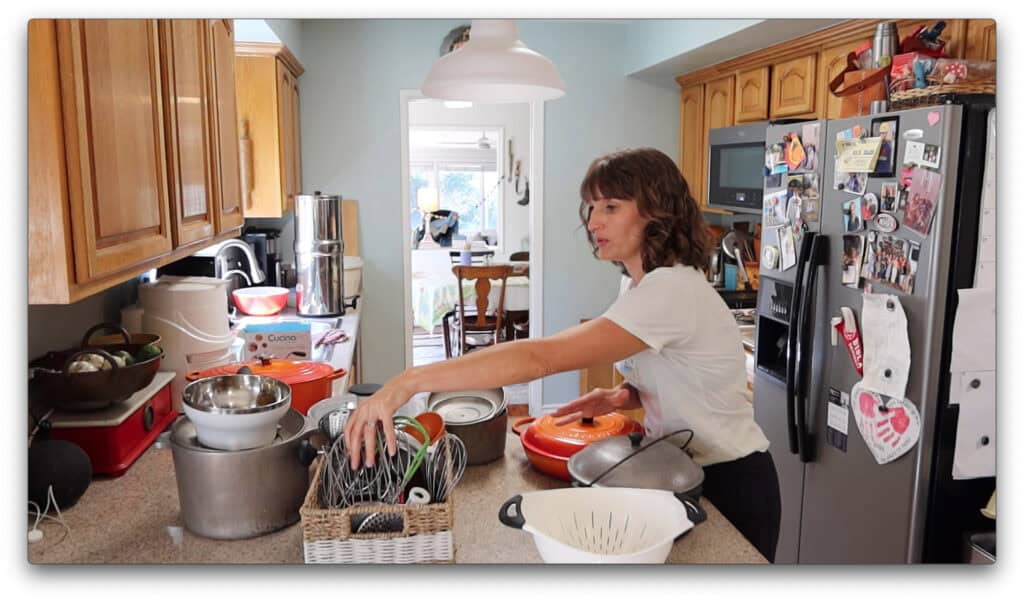
This is what it looked like when we first started decluttering.
Making Better Use of Awkward Spaces
One of the biggest improvements from this project was how we used the open area near the dining room.
Before, the space felt like a large walkway.
It was almost too open, and the furniture didn’t really define how the area should be used.
By bringing the office furniture into that space, we created something that felt like an entirely separate room.
And the best part was that we didn’t need to build walls or make any permanent changes.
We simply rearranged what was already there.
This is a great reminder that you don’t always need more square footage.
Sometimes you just need to use the space you have differently.
Creating a Workspace That Feels Separate
Another benefit of moving Ellen’s desk was that it would no longer be right next to the kitchen.
When I’m trying to work and can see dishes, cleaning, and other household chores, it’s easy to get distracted.
Having a dedicated workspace can help create a little separation between work and home responsibilities.
Even if you don’t have an extra bedroom for an office, you can create a small work area in a dining room, living room, or unused corner.
The key is to make the space work for your needs.
Ellen was especially excited because she occasionally works from home and would now have a bright area for her Zoom calls.
And hopefully, moving the desk away from the front door will also keep it from becoming the family’s dumping ground.
Of course, we joked that she might need to tell everyone right away that this was now her special workspace and not a place to leave their belongings!
Why We Didn’t Buy Anything New
One of the biggest goals of this project was to avoid bringing more stuff into Ellen’s house.
We were actively decluttering, so it didn’t make sense to immediately replace everything with new furniture and organizers.
We had two main reasons for waiting before making purchases.
First, we wanted to make sure the new layout actually worked.
Sometimes you rearrange a room and love it immediately.
Other times, you realize after a few days that something isn’t quite right.
By using what we already had, we could experiment without spending money.
Second, we wanted to focus on having less, not adding more.
It’s so easy to fall into the trap of buying organizing products every time you want to improve your home.
But organizing products don’t necessarily solve clutter problems.
If you have too much stuff, adding more containers can simply give you more places to hide it.
That’s why I always prefer to declutter first.
Once you’ve removed the things you don’t need, you can see what storage is actually necessary.
And sometimes you discover that you don’t need to buy anything at all.
7 Decluttering and Organizing Lessons From This Makeover
After spending the day working on Ellen’s home, there were several lessons that stood out to me.
1. Declutter before rearranging. Moving clutter from one area to another doesn’t solve the problem. Go through your belongings first so you’re only moving what you actually want to keep.
2. Don’t feel obligated to keep every sentimental gift. You can appreciate the person who gave you something without keeping the object forever.
3. Group similar items together. When everything has a logical place, it’s easier to find what you need and keep your home organized.
4. Repurpose furniture before buying new pieces. A table, cabinet, or storage basket might work better in a completely different room.
5. Try temporary organizing solutions. You don’t need to figure out the perfect system immediately. Give yourself time to see how you use the space.
6. Make awkward spaces functional. Sometimes simply changing the furniture arrangement can make your home feel bigger and more useful.
7. Remember that decluttering is a process. You don’t have to make every decision in one day. The more you practice, the easier it becomes to recognize what you truly need and enjoy.
The Results: A Fresh Start Without Spending Money
By the end of the day, we had accomplished so much.
We had gone through the entire cabinet, filled a large donation pile, removed trash, and sorted through many sentimental items.
We also moved furniture around and created a completely new office area for Ellen.
And we did it all without buying anything new!
I think one of the most satisfying things about this project was seeing how much better her home could function simply by changing the layout.
The new office area looked intentional and organized, even though we were using a combination of furniture and storage pieces from different rooms.
And Ellen was excited to start using it.
Of course, this is only phase one of the makeover.
We still have plans to move the refrigerator, create more pantry storage, and continue rearranging the kitchen.
But this first step was important because we made room for those future changes.
Final Thoughts: You Might Already Have Everything You Need
If you’re feeling frustrated with your home, I encourage you to try decluttering and rearranging before spending money on new things.
You might be surprised by how much you can change simply by removing what you no longer need and looking at your furniture in a different way.
I think we sometimes assume that improving our homes requires buying something.
A new cabinet, a new organizer, a new piece of furniture.
But often, the biggest improvements come from simplifying.
When you have less clutter, you have more flexibility to use your space in ways that actually work for your life.
And that’s exactly what we discovered at Ellen’s house.
You don’t always need more stuff to create a better home. Sometimes you just need to use what you already have better.
Stay tuned, we’ll continue this decluttering and home makeover series as we work toward completely rearranging Ellen’s kitchen!
Have you ever rearranged furniture from different rooms and discovered a completely new way to use your space? I’d love to hear about it in the comments!


