
How to Declutter and Organize a Small Kitchen
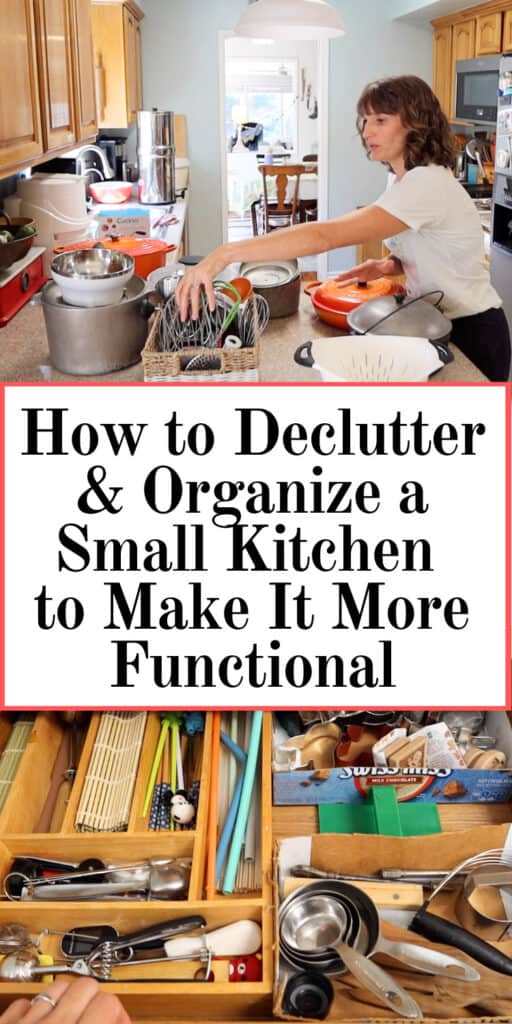
How to Declutter and Organize a Small Kitchen to Make It More Functional
You don’t necessarily need a bigger kitchen. Sometimes, you just need to make better use of the kitchen you already have.
Recently, I’ve been helping my friend Ellen declutter and rethink the way her kitchen functions. This isn’t a huge kitchen, and like many homes, storage has slowly become a problem over the years.
Things get pushed to the back of cabinets. We accumulate duplicates. Small appliances take up valuable space. Kids outgrow things. We buy kitchen gadgets with good intentions and then realize we never actually use them.
Eventually, you can have cabinets packed full of stuff while still feeling like you don’t have enough storage.
That was one of the biggest things we discovered while working on Ellen’s kitchen.
Instead of immediately buying organizers or thinking about adding more storage, we started by asking a much simpler question:
What actually needs to be in this kitchen?
By the time we finished decluttering, we had opened up space throughout the kitchen, cleared more off the countertops, emptied an entire cabinet above the refrigerator, and made everyday items much easier to access.
And Ellen still had everything she needed to cook for her family.
Here are some of the biggest lessons from this kitchen declutter and how you can use them in your own home.
1. Declutter Before You Try to Organize
This is probably the most important rule when reorganizing any space.
Don’t start with organizers.
Don’t start by buying baskets.
Don’t start by trying to rearrange everything you own.
First, figure out what you actually want to keep.
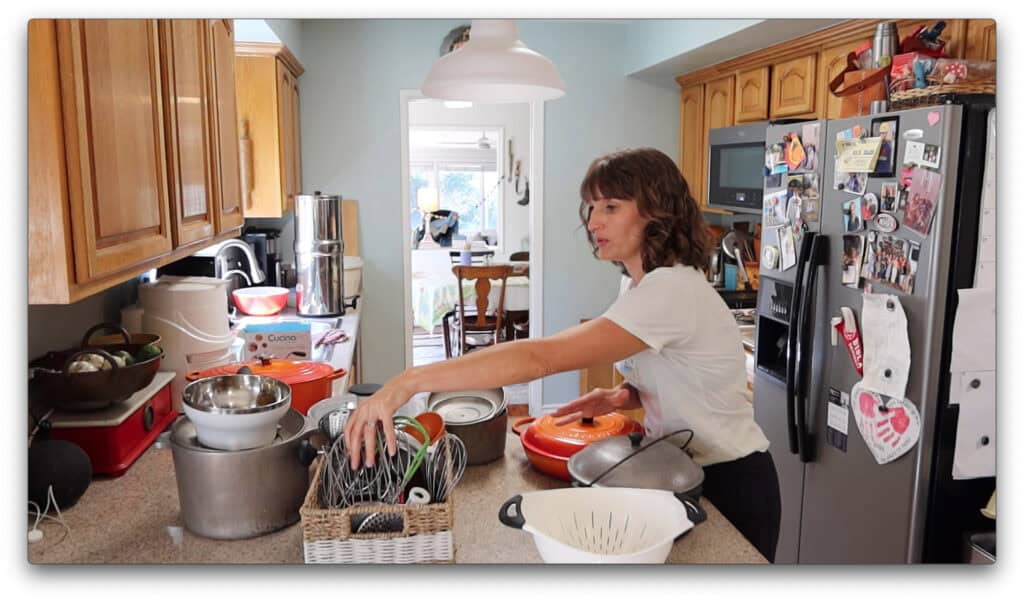
We went cabinet by cabinet and drawer by drawer through Ellen’s kitchen. In some areas, we pulled everything out. In others, we could easily see what was there and simply worked through the items one at a time.
As we went, we asked questions like:
- Do you use this?
- Do you like using it?
- Do you have another one?
- Is it still good?
- Is it broken or missing pieces?
- Does this need to live in the kitchen?
- Would you buy this again today?
Once you got rid of unnecessary items, organizing became surprisingly easy.
That’s because sometimes the problem isn’t your organization system.
The problem is simply that you’re trying to organize too much stuff.
2. Check the Things Hiding in the Back
One of the first areas we tackled was the spice cabinet.
Spices are a perfect example of something that can quietly accumulate. You buy a new container without realizing you already have one. Something gets pushed behind everything else. You buy an ingredient for one recipe and never use it again.
We found duplicates as well as spices that hadn’t been used in years.
We went through everything, got rid of what Ellen no longer used, checked dates, combined duplicates where it made sense, and grouped the remaining spices by how she uses them.
Suddenly, she could actually see what she had.
This is worth doing with more than spices. Check the backs of your cabinets for:
- Sauces and oils
- Baking ingredients
- Canned food
- Vitamins and supplements
- Tea and coffee
- Pantry staples
- Cleaning supplies
If you haven’t seen something in several years, there’s a good chance you’ve forgotten you own it.
3. Look for Duplicates
Duplicates were another easy category to tackle.
At one point, we discovered three bottles of rice vinegar. We also found duplicate spices and multiple kitchen utensils that essentially did the same job.
This doesn’t mean you can never own two of something.
If you regularly use several spatulas while cooking, keep them. If you need multiple mixing bowls, keep them.
The important question is whether the duplicates are intentional.
There is a big difference between:
“I own three of these because I regularly use all three.”
and
“I own three because I forgot I already had two.”
Keeping only the duplicates you actually need can create a surprising amount of space.
4. Stop Giving Prime Storage Space to Things You Rarely Use
Not every kitchen item deserves the same amount of accessibility.
If you use something every day, it should be easy to reach.
If you use it twice a year, it doesn’t need to take up the best drawer in your kitchen.
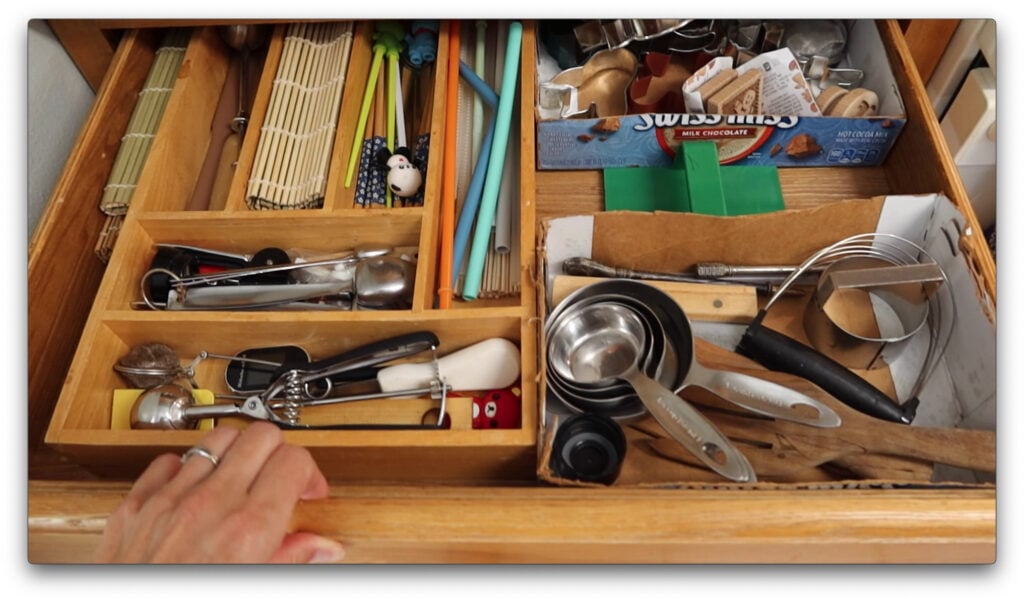
For example, Ellen had cookie cutters taking up valuable drawer space even though she doesn’t use them frequently. Instead of getting rid of them, we grouped them together and moved them to a less convenient storage area.
We did the same thing with other specialty items.
This is especially helpful in a small kitchen.
Think of your storage in levels:
Prime storage: Everyday dishes, utensils, pots, pans, cooking tools, and ingredients.
Secondary storage: Things you use occasionally.
Hard-to-reach storage: Seasonal and specialty items you want to keep but don’t need regularly.
You don’t necessarily have to declutter something simply because you rarely use it.
You might just need to stop storing it in your kitchen’s most valuable real estate.
5. Declutter Based on Your Life Now
Kitchens can become little time capsules.
We found items Ellen’s children had used when they were younger but no longer needed. There were specialty gadgets that had been tried and weren’t successful. There were pieces from appliances that were no longer used.
These things aren’t necessarily bad.
They’re simply no longer useful for the life happening in the house today.
This is a question I find helpful when decluttering:
Does this belong to my current life or a past version of my life?
Maybe you used to bake constantly.
Maybe your children were little.
Maybe you used to entertain large groups.
Maybe you went through a smoothie phase.
Maybe you bought an Instant Pot and realized you don’t actually like using it.
Your kitchen should support the way you cook and live now.
6. Keep the Things You Truly Use
Decluttering isn’t about getting rid of as much as possible.
Ellen cooks a lot, so when we got to her pots and pans, she decided to keep them.
And that was completely fine.
Instead of forcing her to get rid of useful cookware just to have fewer things, we reorganized the cabinet so everything fit better.
Because we had already removed some unnecessary items, we even had enough room to move a pot that had been living on the countertop into the cabinet.
That’s the goal.
Not fewer things just for the sake of having fewer things, but enough space for the things you actually use.
7. Clear the Countertops Whenever Possible
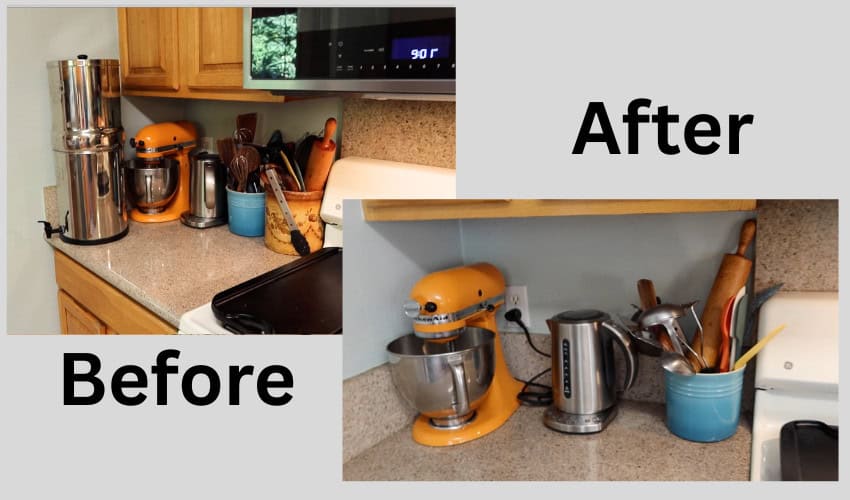
One of our goals was to get more things off Ellen’s countertops.
She had two large containers holding spatulas, wooden spoons, and other cooking utensils.
Once we decluttered her utensil drawers, we realized many of those tools could fit inside the drawers instead.
That meant fewer containers sitting on the counter.
This can make an enormous visual difference.
A kitchen can technically be organized and still feel cluttered if every countertop is covered.
If you want your kitchen to feel calmer and larger, look around your counters and ask:
Does this really need to live here?
Try putting away anything you don’t use almost every day.
You may be surprised by how different your kitchen feels.
8. Don’t Be Afraid to Leave Empty Space
This might have been one of my favorite parts of this kitchen declutter.
We emptied an entire cabinet above the refrigerator.
Instead of immediately looking for something to put inside it, we left it empty.
When organizing, we tend to think every cabinet, drawer, and shelf needs to be filled.
It doesn’t.
Empty space gives you flexibility.
In Ellen’s case, we are also thinking ahead to some changes we may make to the kitchen layout. Leaving that cabinet empty makes those future changes easier.
But even if you’re not planning a kitchen project, having a little extra room is incredibly helpful.
It allows groceries to fit.
It makes things easier to put away.
It gives your belongings breathing room.
And it prevents your cabinets from getting packed again right away.
9. Think About the Kitchen as a Whole
This declutter wasn’t only about getting rid of things.
We’re also starting to reenvision how Ellen’s kitchen could function better.
Right now, a closet outside the kitchen has essentially become an overflow pantry. Food and small appliances have migrated into it because there hasn’t been enough room in the actual kitchen.
Our long-term goal is to see whether we can make the kitchen functional enough that the kitchen items can come back into the kitchen and the closet can return to its original purpose.
We’re also looking at the refrigerator area because the current layout creates a traffic jam.
These are bigger projects we’ll tackle later, but decluttering first lets us see the possibilities.
And I think that’s an important part of the process.
Before assuming you need a bigger kitchen, more cabinets or an expensive renovation, remove everything that doesn’t need to be there.
Then reevaluate the space.
You might see possibilities that were completely hidden by the clutter.
10. Make Your Kitchen Fit You
There is no perfect way to organize a kitchen.
Some people want absolutely nothing on their counters.
Some people want their cooking tools sitting next to the stove.
Some people bake constantly and need baking supplies front and center.
Other people haven’t baked anything in five years.
The goal isn’t to copy someone else’s kitchen.
The goal is to make yours work for you.
As we went through Ellen’s things, we kept items that were sentimental, useful, or meaningful to her. She kept kitchen tools I wouldn’t personally need because she uses them. She let go of other things because they no longer served her.
That’s exactly how decluttering should work.
What We Learned From Decluttering This Small Kitchen
By the end of this decluttering session, we had gone through every remaining cabinet and drawer.
A large pile was ready to leave the house.
But the biggest transformation wasn’t the pile of stuff leaving.
It was the space we gained.
The cabinets had more room. The countertops were clearer. Everyday items were easier to find. Things that belonged together were finally stored together.
And despite everything Ellen decluttered, she still had everything she needed to cook for her family.
I think that’s such a good reminder that having more kitchen stuff doesn’t necessarily make a kitchen more functional.
Sometimes, it does the exact opposite.
If your kitchen feels too small, crowded, or difficult to use, don’t assume you need to renovate it.
Start with one cabinet.
Take everything out.
Decide what you actually use.
Remove the duplicates, broken items, forgotten gadgets, and things that belong to another season of your life.
Then put back what remains in a way that makes sense for how you live today.
You might discover your kitchen has much more space than you thought.
And once the clutter is gone, you can finally see what the space actually needs.



Having run into this myself, the description rings true. The first sign of trouble is usually noise, and acting on it rarely helps. I suspect the same applies in other settings.
Ellen sounds exactly like me six months ago — my counters were a graveyard of single-purpose gadgets I’d used twice. Your point about using what you already have before buying more storage really stuck with me. I’m stealing the ‘zone by activity, not by drawer’ idea this weekend.