How to Declutter Your Husband’s Closet (Without Doing It for Him)
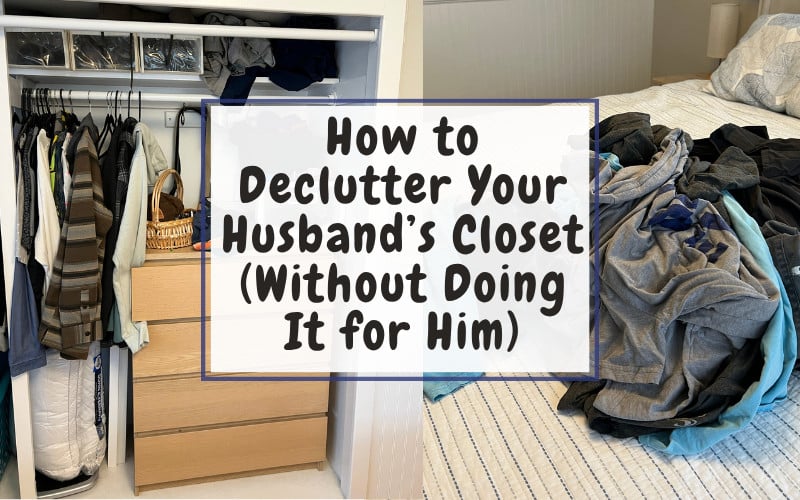
Decluttering your own closet is one thing. Decluttering someone else’s closet is a completely different experience.
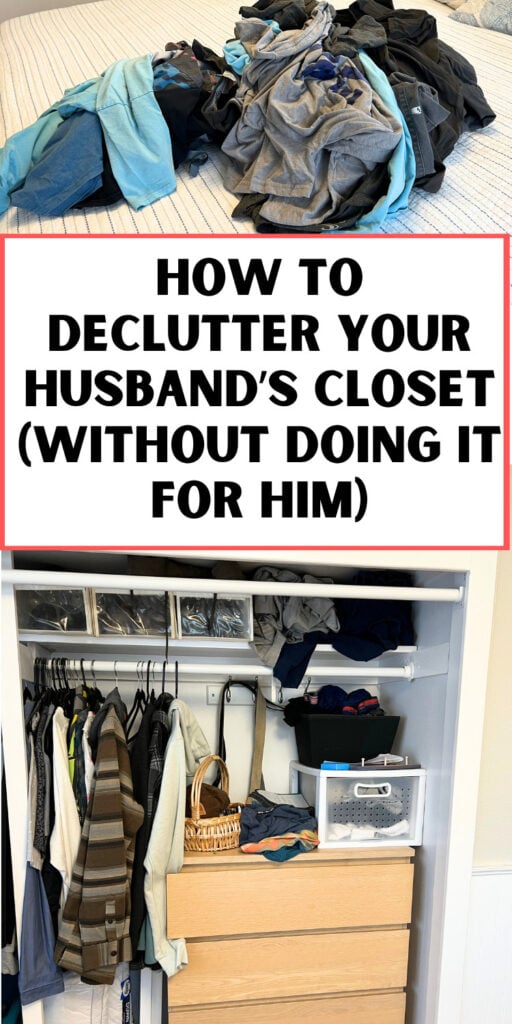
Recently, I helped my husband, Grant, go through his side of our closet. His wardrobe had slowly become a mixture of everyday clothes, nicer clothes, work clothes, and clothes that probably should have been retired a long time ago.
Because Grant does a lot of woodworking, painting, and projects around the house, his wardrobe is a little different from mine. A perfectly good shirt can quickly become a work shirt after one afternoon in the garage. Eventually, those work clothes become stained, ripped, worn out, or permanently hold onto smells that no amount of washing seems to remove.
Over time, everything had started getting mixed together. Even putting away the laundry had become confusing because I didn’t always know what a work shirt was, what a nice shirt was, or where anything belonged.
How to Declutter Your Husband’s Closet (Without Doing It for Him)
We decided it was time for a closet reset.
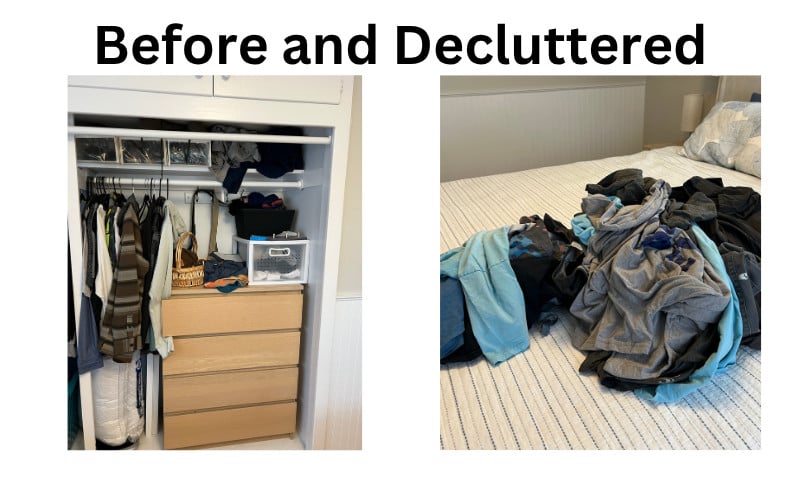
By the end, we had removed 23 items from his wardrobe and, maybe even more importantly, figured out a much better way to organize what remained.
Here are a few things I learned along the way.
Start Small Instead of Emptying the Entire Closet
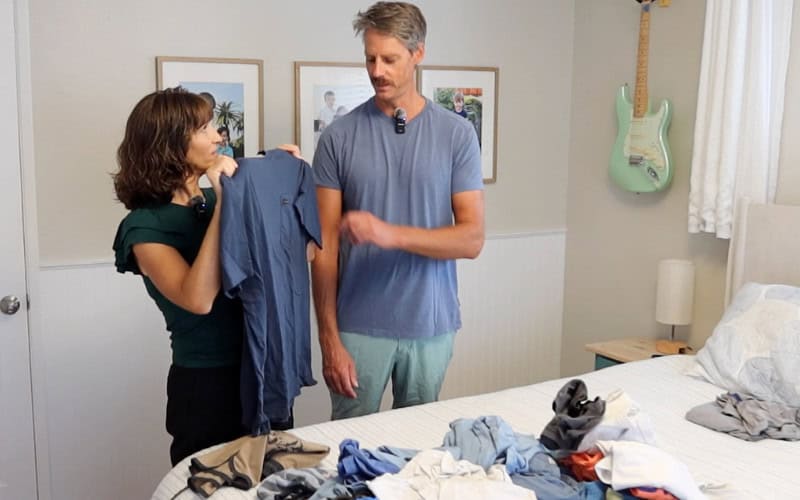
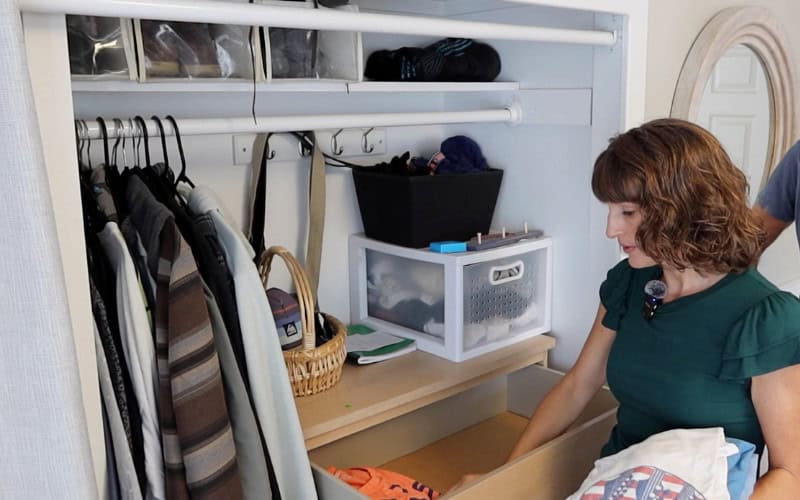
Although you often hear the advice to take absolutely everything out of your closet when decluttering, we decided to work through Grant’s clothes one drawer at a time.
We pulled out the first drawer, put everything on the bed, and went through each piece individually.
This kept the project from becoming overwhelming.
If you’re helping someone who isn’t particularly excited about decluttering, I think this approach can work especially well. Instead of announcing that you’re spending the entire day going through their wardrobe, start with:
- One drawer
- One shelf
- T-shirts
- Shorts
- Hanging clothes
Once you get going, it’s usually much easier to continue.
Remember: You’re Helping, Not Deciding
This is probably the most important rule when decluttering someone else’s belongings.
They have to make the final decision.
There were definitely things in Grant’s closet that I would have gotten rid of immediately. But they aren’t my clothes.
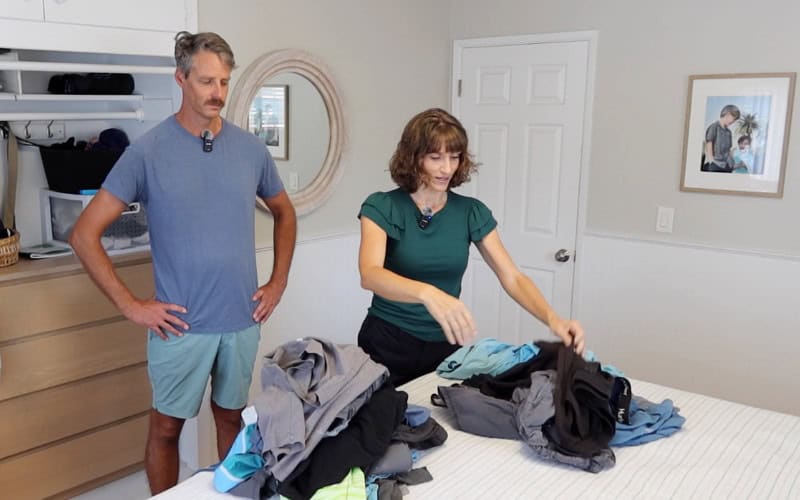
My job was mostly to hold things up and ask:
Keep or get rid of?
Sometimes I pointed out that something was stained, had a hole, didn’t fit well, or hadn’t been worn in a long time. But ultimately, Grant decided what stayed.
This is especially important if you’re decluttering with a spouse. You might not understand why they want to keep something, and that’s okay.
Grant has an extremely old sleeveless sweatshirt from New Zealand that has a giant hole in it. I certainly wouldn’t consider it an essential wardrobe item, but he loves it.
So it stayed.
Decluttering isn’t about convincing someone to get rid of everything you wouldn’t personally keep. It’s about helping them decide what still deserves space in their life.
Create a Maybe Pile
Not every decision needs to happen immediately.
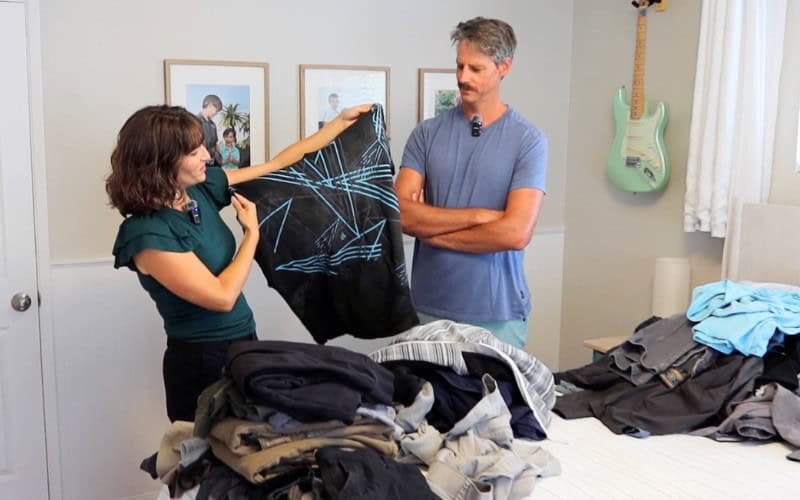
We created a maybe pile for anything Grant wasn’t sure about.
What I like about doing this is that you can come back to those items after you’ve seen everything else.
A shirt might seem worth keeping when you’re looking at it by itself. But after discovering ten other shirts you like more, suddenly that questionable shirt becomes much easier to let go.
That’s exactly what happened with one of Grant’s shirts. By the end of the decluttering session, he looked at how many shirts he already had and decided he didn’t need the “maybe” after all.
Sometimes perspective makes the decision for you.
Be Realistic About the Clothes You Actually Need
One thing that became very obvious during this declutter was that Grant legitimately needs work clothes.
He’s constantly woodworking, painting, building, and working outside. Buying a wardrobe full of beautiful clothes that he’s afraid to get dirty wouldn’t make sense for his actual life.
At the same time, we realized we had allowed too many worn-out clothes to stay simply because they could technically be used for work.
There is a limit.
A stained shirt can become a project shirt. But eventually that project shirt becomes ripped, smelly, uncomfortable, or so worn out that it’s simply time for it to go.
The same thing applies to clothes you keep for:
- Gardening
- Painting
- Cleaning
- Exercising
- Lounging around the house
- Camping
- Messy projects
Having a few older items for these activities makes sense.
Having 25 of them probably doesn’t.
Give yourself a reasonable limit for each category.
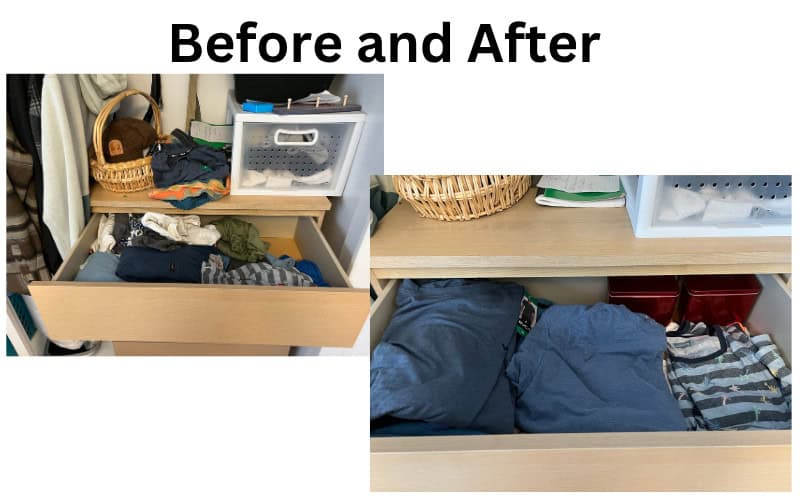
Separate Clothes by How You Actually Use Them
This was probably our biggest organizational problem.
Grant had work shirts mixed with nicer shirts, shorts mixed together, and different categories spread throughout the drawers.
Since I often put away the laundry, I would look at something and wonder, Is this a work shirt? Is this a good shirt? Where does this go?
Eventually, I would just put things wherever they fit.
That was a sign that our organization system wasn’t working.
After decluttering, we divided everything into categories that actually made sense for his life:
- Nice shirts
- Tank tops and sun shirts
- Work shirts
- Work shorts
- Nice shorts
- Pants
- Winter clothing
Your categories might be completely different.
The important thing is that when you open a drawer, you immediately understand what belongs there.
A good organization system shouldn’t require you to think every time you put something away.
Let Newer Clothes Graduate Into Work Clothes
We also came up with a system that I hope will help us going forward.
When Grant gets a new shirt, we’re going to try to keep it as a “nice” shirt for a while.
As it gets older or starts showing wear, it can graduate into the work-clothes category.
Then, once the work clothes are truly worn out, they can leave the wardrobe completely.
Think of it as a clothing life cycle:
Nice clothes → everyday clothes → work clothes → let go
Obviously, not every piece of clothing needs to follow this exact path, but for someone who regularly does messy projects, it makes a lot of sense.
It also prevents us from keeping every old shirt simply because “you can wear it for work.”
Decluttering Shows You What You Actually Need
One of my favorite things about decluttering is that it doesn’t just show you what you have too much of.
It shows you what you’re missing.
Once we went through Grant’s shorts, we discovered that he had plenty of work shorts but hardly any nicer shorts.
Before decluttering, the drawer was full, so it felt like he had plenty of shorts.
But a full drawer doesn’t necessarily mean you have the clothes you actually need.
Now, instead of randomly buying more clothes, we know exactly what would be useful to add to his wardrobe.
This is one reason I think it’s helpful to declutter before shopping.
You might discover that you don’t need more clothes; you simply need the right clothes.
Get Rid of Clothes That Have Reached the End
Some clothing decisions are complicated.
Others really aren’t.
During our declutter, we found clothes that:
- Had holes
- Didn’t fit
- Were uncomfortable
- Were permanently stained
- Had become worn out
- Hadn’t held up well
- Were never really liked in the first place
Sometimes we hold onto clothing because technically we could still wear it.
But that’s not the same as actually wanting to wear it.
If you continually pass over an item because there’s always something better to choose, that tells you something.
You don’t have to wait until a piece of clothing is completely unusable before giving yourself permission to let it go.
Your Closet Should Fit Your Real Life
One thing I was reminded of during this process is that there’s no such thing as the perfect wardrobe.
The goal isn’t to own a certain number of shirts or create an Instagram-worthy closet.
Your wardrobe needs to work for the life you’re actually living.
For Grant, that means having more work clothes than someone who spends every day in an office.
Someone else might need business clothes, workout clothes, uniforms, gardening clothes, or formal clothes.
Instead of asking:
“How many clothes should I own?”
Try asking:
“Do the clothes I own support the life I’m actually living?”
That’s a much more useful question.
Decluttering Someone Else’s Closet Can Actually Be Helpful
If your spouse isn’t naturally interested in decluttering, sometimes simply having another person there makes the process easier.
I pulled everything out, held things up, created the piles, asked the questions, and helped reorganize everything afterward.
Grant made the decisions.
That division of labor worked really well for us.
And by the end of our closet declutter, 23 items were leaving.
Even better, we could clearly see what he had, what he needed, and how everything should be organized going forward.
That’s the part of decluttering that I think is often overlooked.
The goal isn’t just to get rid of stuff.
The goal is to make everyday life easier.
If opening a drawer means you can immediately find what you need, putting away laundry takes less thought, and getting dressed is easier, then the decluttering session was worth it.
And if you’re thinking about tackling your spouse’s closet, remember: you don’t need to finish everything in one day.
Pull out one drawer.
Ask, “Keep or get rid of?”
And see where it goes.